
The Master Guide to Measuring a Box: Save Money and Prevent Shipping Headaches
In the fast-paced world of 2026 e-commerce, a single inch can be the difference between a profitable sale and a shipping bill that eats your entire margin. Whether you are a small business owner or a logistics manager, knowing exactly how to measure a box for shipping is a fundamental skill.
At Custom Boxes BL, we see thousands of brands struggle with “Dimensional Weight” surcharges simply because they measured their boxes incorrectly. This guide will walk you through the industry standards, the math behind the costs, and the pro tips you need to keep your shipping efficient.
1. The Industry Standard: Length x Width x Height (LxWxH)
When you are ordering from Custom Boxes BL or booking a shipment with UPS, FedEx, or USPS, you must always provide dimensions in a specific order. If you mix these up, your box might not fit the carrier’s conveyor belts or your product might not fit the box.
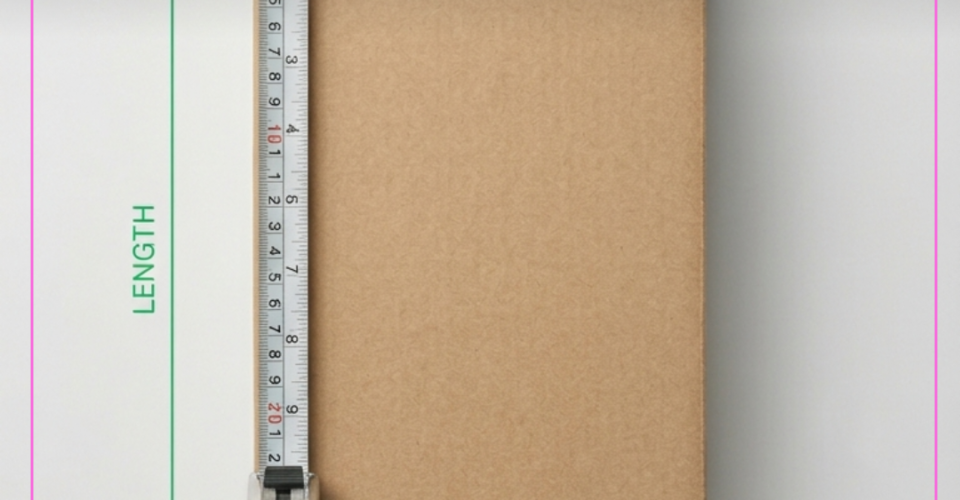
- Step 1: Length (L): Find the longest side of the box when looking at the opening (the side with the flaps).
- Step 2: Width (W): This is the shorter side when looking at the top of the box.
- Step 3: Height (H) or Depth (D): This is the vertical side of the box, measured from the bottom to the top of the opening.
Pro Tip: Always measure to the nearest whole inch. If your box is $12.1$ inches, carriers will round up to $13$ inches. Those “fractions” add up to real dollars over time.
2. Internal vs. External Dimensions: Which One Matters?
This is where most mistakes happen. At Custom Boxes BL, we always ask our clients: “Are you measuring for the product or the carrier?”
A. Internal Dimensions (For Your Product)
The industry standard for box manufacturers is based on Internal Dimensions. This ensures your product fits snugly inside. When you tell us you need a $10 \times 10 \times 10$ box, we make sure the inside space matches those numbers.
- Why it matters: Corrugated cardboard has thickness (fluting). A box that is $10$ inches on the outside might only be $9.5$ inches on the inside.
B. External Dimensions (For the Carrier)
Carriers like FedEx and UPS care about the External Dimensions. They need to know how much space your box takes up in their truck.
- How to measure: Always measure from the widest point, including any “bulges” in the cardboard or extra layers of packing tape.
3. Understanding Dimensional Weight (DIM Weight) in 2026
In 2026, carriers don’t just charge you for how much a box weighs; they charge you for how much space it takes up. This is called Dimensional Weight.
The standard formula used by major US carriers is:
$$\text{DIM Weight} = \frac{\text{Length} \times \text{Width} \times \text{Height}}{\text{DIM Factor}}$$
- The 2026 DIM Factor: For most domestic retail shipments, the divisor is 166. For commercial daily rates, it is often 139.
- The Result: If your package is $20 \times 20 \times 20$ inches but only weighs $5$ lbs, the carrier will calculate $(20 \times 20 \times 20) / 166 \approx 48.1$ lbs. You will be charged for 49 lbs, not 5 lbs.
The Custom Boxes BL Solution: We specialize in “Right-Sizing.” By reducing your box dimensions by just one inch in each direction, we can often save our clients 15–30% in annual shipping costs.
4. How to Measure Irregularly Shaped Boxes
Not every box is a perfect cube. If you are shipping a tube, a triangular prism, or a poly-mailer, follow the “Rectangular Prism” Rule:
- Imagine the box is inside a transparent rectangular crate.
- Measure the longest, widest, and tallest points of that “invisible” crate.
- For tubes, the length is the height, and the width/height are both the diameter of the circular end.
5. Essential Tools for the Job
To get accurate measurements that won’t be disputed by carriers, skip the office ruler. Use these tools recommended by the Custom Boxes BL production team:
- Steel Tape Measure: Far more accurate than plastic or cloth tapes that can stretch over time.
- Caliper: If you are measuring the thickness of the board (important for heavy-duty shipping).
- Weight Scale: Always measure the box after it is packed and taped.
Summary: Accuracy is Your Best Cost-Saving Tool
Measuring a box seems simple, but in the logistics environment of 2026, it is a high-stakes calculation. By following the LxWxH standard, understanding the difference between Internal and External dimensions, and mastering the DIM Weight formula, you protect your brand from unexpected surcharges.
At Custom Boxes BL, we don’t just provide the boxes; we provide the expertise to ensure those boxes move through the world as efficiently as possible.
Are you tired of paying for “air” in your shipments?
Contact Custom Boxes BL today. Our structural designers can help you audit your current box sizes and find the perfect, cost-effective dimensions for your product lineup.